Free CISO toolkit & security executive tools

Executive Cyber Intelligence Suite

A free CISO toolkit of five cybersecurity assessment calculators and security executive tools that answer the questions an executive board asks about cyber risk — what is happening, how prepared we are, what it could cost, what must happen when something goes wrong, and how we report performance. Built by Dr. John Iliadis and presented as one integrated suite: evidence of applied cybersecurity leadership, not standalone utilities.

Iliadis Executive Cyber Intelligence Suite — the five cybersecurity assessment calculators and security executive tools: ThreatPulse, CyberPulse, QuickRisk, EU Cyber Incident and BRIG

One suite, five executive questions

A single decision cycle

Each security executive tool answers the question an executive asks at a different stage of the cyber-risk cycle.

  1. Detect ThreatPulse What is happening?
  2. Assess CyberPulse How prepared are we?
  3. Quantify QuickRisk What matters financially & operationally?
  4. Respond EU Cyber Incident What happens if something goes wrong?
  5. Report BRIG How do we report performance?

A closed loop — incident response and regulatory exposure and board reporting feed straight back into threat awareness. Find out more about the most recent cybersecurity applications I have authored, at my Github repositories.

The five applications

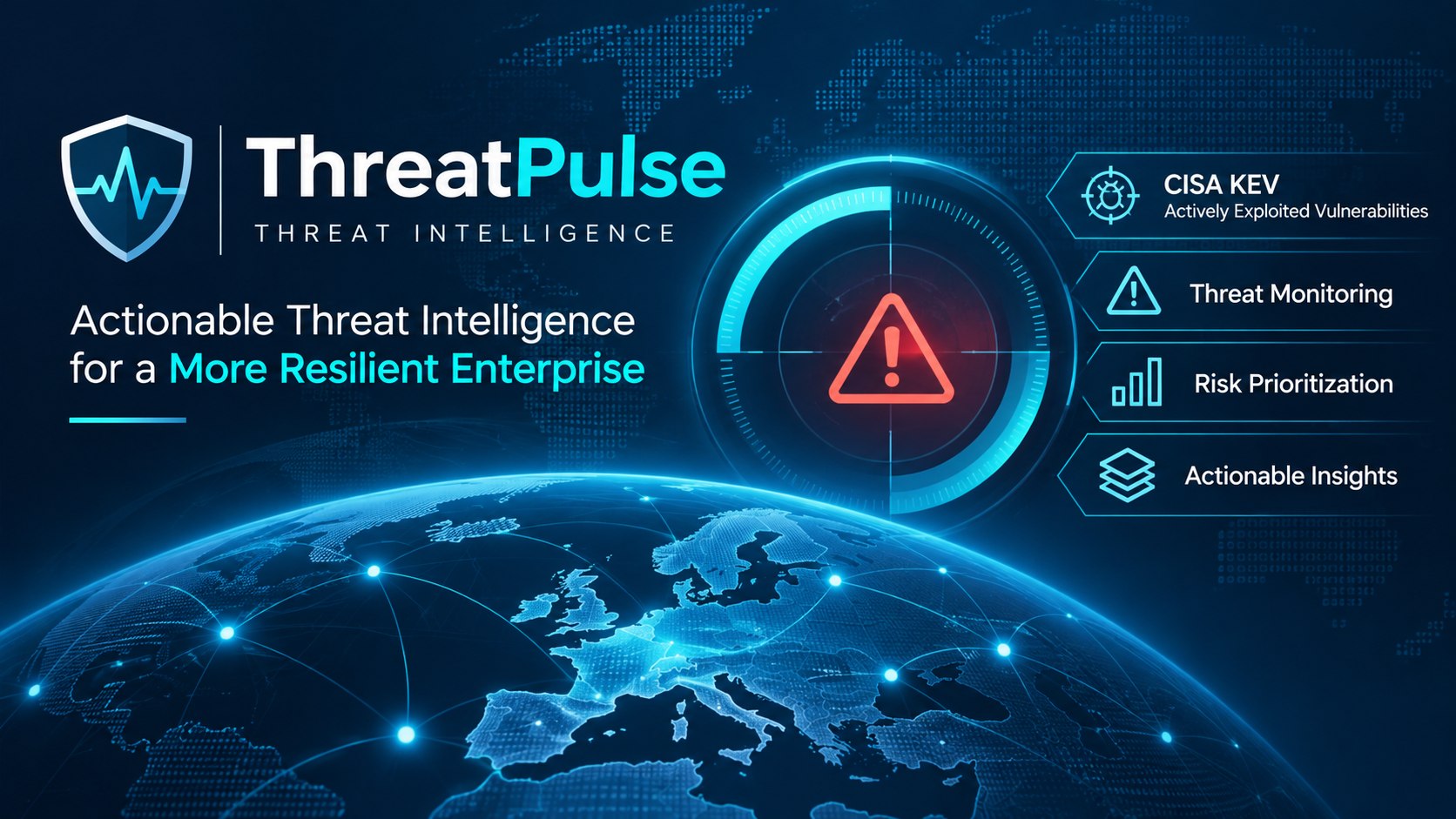
ThreatPulse banner — a threat-intelligence emblem and a radar gauge with a warning indicator, alongside panels for the CISA Known Exploited Vulnerabilities catalogue, threat monitoring, risk prioritization and actionable insights, over a wireframe globe of Europe
Detect

ThreatPulse

What is happening?

Prioritise the vulnerabilities and threats that deserve attention first, using normalised, scored threat intelligence.

ThreatPulse is a threat-intelligence and vulnerability-prioritization application that collects and normalizes current cyber-threat information to help cybersecurity professionals identify which vulnerabilities and threats deserve attention first. It brings together sources such as the CISA Known Exploited Vulnerabilities (KEV) catalogue and applies prioritization and scoring so that security teams can focus on the items most likely to matter rather than working through unfiltered feeds. ThreatPulse is an independently developed analytical application intended to support, not replace, professional judgement: its prioritization reflects the sources and scoring applied at the time of viewing and is not an assessment, certification or endorsement by CISA or any other authority. Users should validate findings against their own vulnerability-management, threat-intelligence and risk processes before acting on them.

Runs on a separate host: threatpulse.iliadis.net
Launch ThreatPulse →

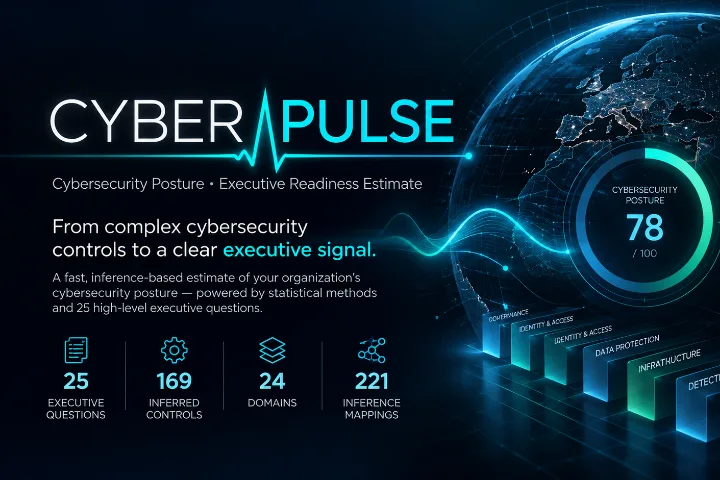
CyberPulse banner — a cybersecurity posture estimate of 78 out of 100, with 25 executive questions, 169 inferred controls, 24 domains and 221 inference mappings
Assess

CyberPulse

How prepared are we?

Turn 25 executive questions into a directional, evidence-based read on cybersecurity posture.

CyberPulse uses 25 high-level executive questions and statistical inference to provide an initial, directional indication of an organization's cybersecurity posture and highlight areas that may warrant further investigation or improvement. It is designed as a faster starting point than a detailed control-by-control assessment, using probabilistic methods and Monte Carlo analysis to represent uncertainty in the inferred results. CyberPulse is an independently developed analytical application and is not an official tool, certification, assessment or representation of the Greek National Cybersecurity Authority. Its results are indicative and should not be treated as a cybersecurity audit, compliance assessment, certification, professional advice or definitive representation of an organization's security posture.

Launch CyberPulse →

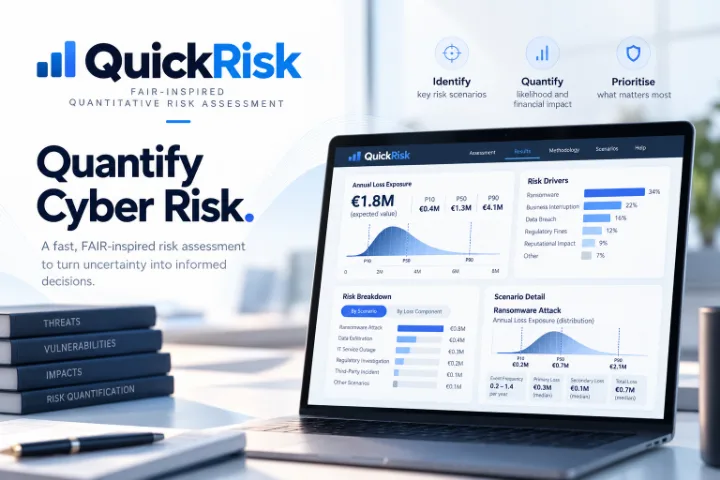
QuickRisk banner — a quantitative cyber-risk dashboard showing an expected annual loss exposure of 1.8 million euro with P10, P50 and P90 ranges, ranked risk drivers and a per-scenario loss breakdown
Quantify

QuickRisk

What matters financially & operationally?

Express cyber exposure as a range of possible loss rather than a single, misleading score.

QuickRisk is a FAIR-inspired quantitative cyber-risk assessment tool designed to turn uncertainty about cyber events and their potential impact into a more decision-oriented view of risk. It uses probabilistic modelling and quantitative analysis to explore the possible range of loss associated with defined cyber-risk scenarios rather than presenting risk as a single deterministic score. The tool is intended as a rapid, practical starting point for understanding likelihood, loss exposure, uncertainty and risk drivers. It is FAIR-inspired rather than a substitute for a full FAIR analysis, detailed risk assessment, professional judgement or organisation-specific quantitative modelling. Users should interpret results in the context of the assumptions and information entered into the assessment.

Runs on a separate host: quickrisk.iliadis.net

Launch QuickRisk →

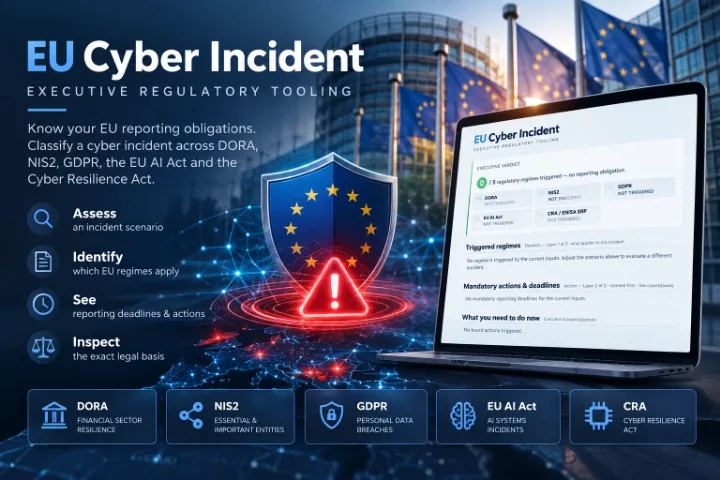
EU Cyber Incident banner — incident classification across DORA, NIS2, GDPR, the EU AI Act and the CRA, with the EU shield emblem and a reporting-deadline dashboard
Respond

EU Cyber Incident

What happens if something goes wrong?

Classify an incident and surface the regulatory deadlines and obligations that follow.

EU Cyber Incident is an executive regulatory discovery and SLA engine for exploring potential reporting and response obligations following a cyber incident. It helps classify an incident against major EU regulatory regimes including DORA, NIS2, GDPR, the EU AI Act and the Cyber Resilience Act, then presents applicable actions, deadlines and supporting legal references. The tool is designed to help cybersecurity, technology, risk and executive teams quickly understand the potential regulatory blast radius of an incident and identify what may require attention first. It is a preliminary discovery and educational simulation tool, not legal, regulatory, compliance or professional advice. Users should validate material decisions against the applicable legislation, competent authorities and qualified professional advice.

Launch EU Cyber Incident →

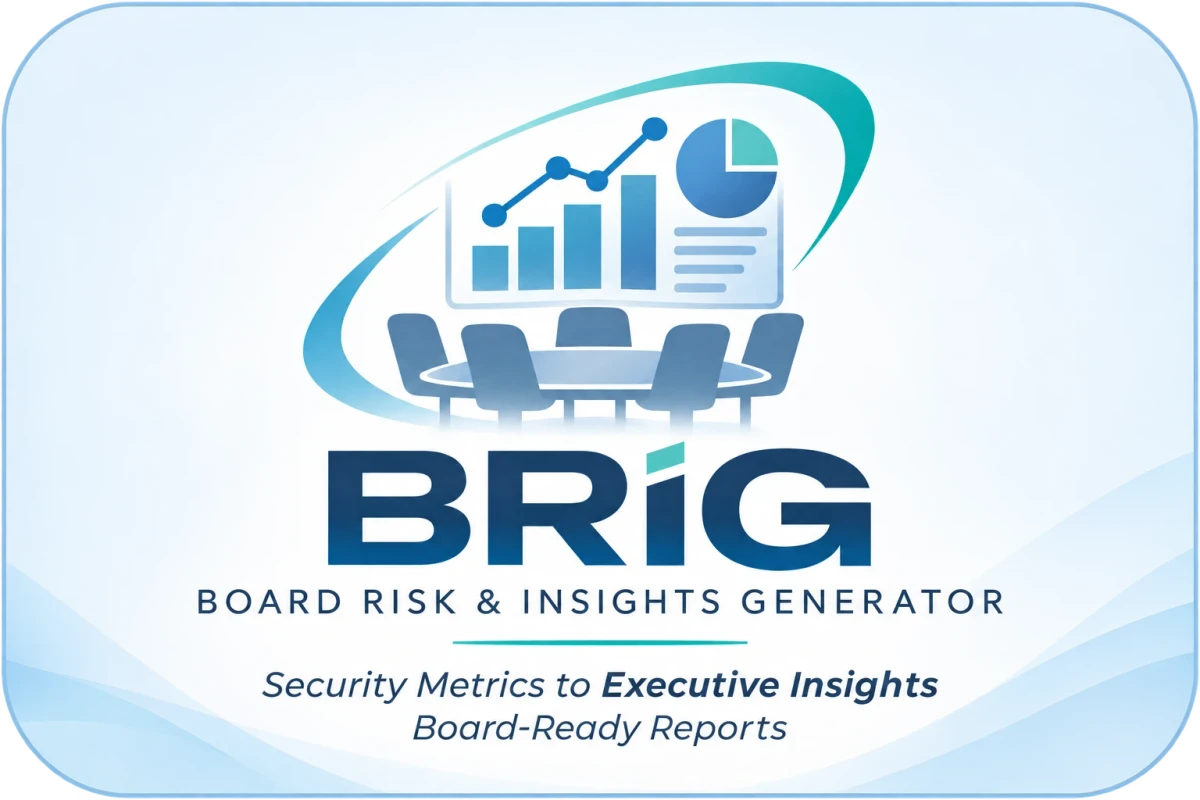
BRIG banner — Board Risk and Insights Generator: a cybersecurity metrics dashboard with bar charts, a trend line and a pie chart, captioned Security Metrics to Executive Insights and Board-Ready Reports
Report

BRIG

How do we report performance?

Turn cybersecurity metrics into board-ready reports and executive insights.

BRIG (Board Risk & Insights Generator) is a cybersecurity reporting application that turns security metrics into board-ready reports and executive insights. It translates technical and operational cyber data — such as control coverage, risk posture, incidents and remediation trends — into clear graphs, statistics and AI-enhanced insights that boards and executive committees can understand and act on. BRIG helps technology and cyber leaders communicate security performance and risk in business terms. It is an independently developed analytical application intended to support, not replace, professional judgement, and its outputs should be validated against its own data and governance processes before being presented to a board.

Runs on a separate host: brig.iliadis.net

Launch BRIG →

Evidence of capability

A suite, not five experiments

Each application operationalises a discipline Dr. John Iliadis practises as a technology and cybersecurity executive — threat operations, security posture, quantitative risk, EU regulatory response under DORA, NIS2, GDPR, the EU AI Act and the Cyber Resilience Act, and board-level security reporting.

Together they form one repeatable decision cycle: detect the threat landscape, assess preparedness, quantify exposure, respond within regulatory deadlines, and report performance to the board — the working method of a 20+ year career spent turning technical and regulatory complexity into decisions a board can act on.

Built on

  • PhD · Information Security
  • CISSP · CISM · CRISC · C|CISO
  • 20+ years cyber leadership
  • ISC2 Hellenic Chapter leadership